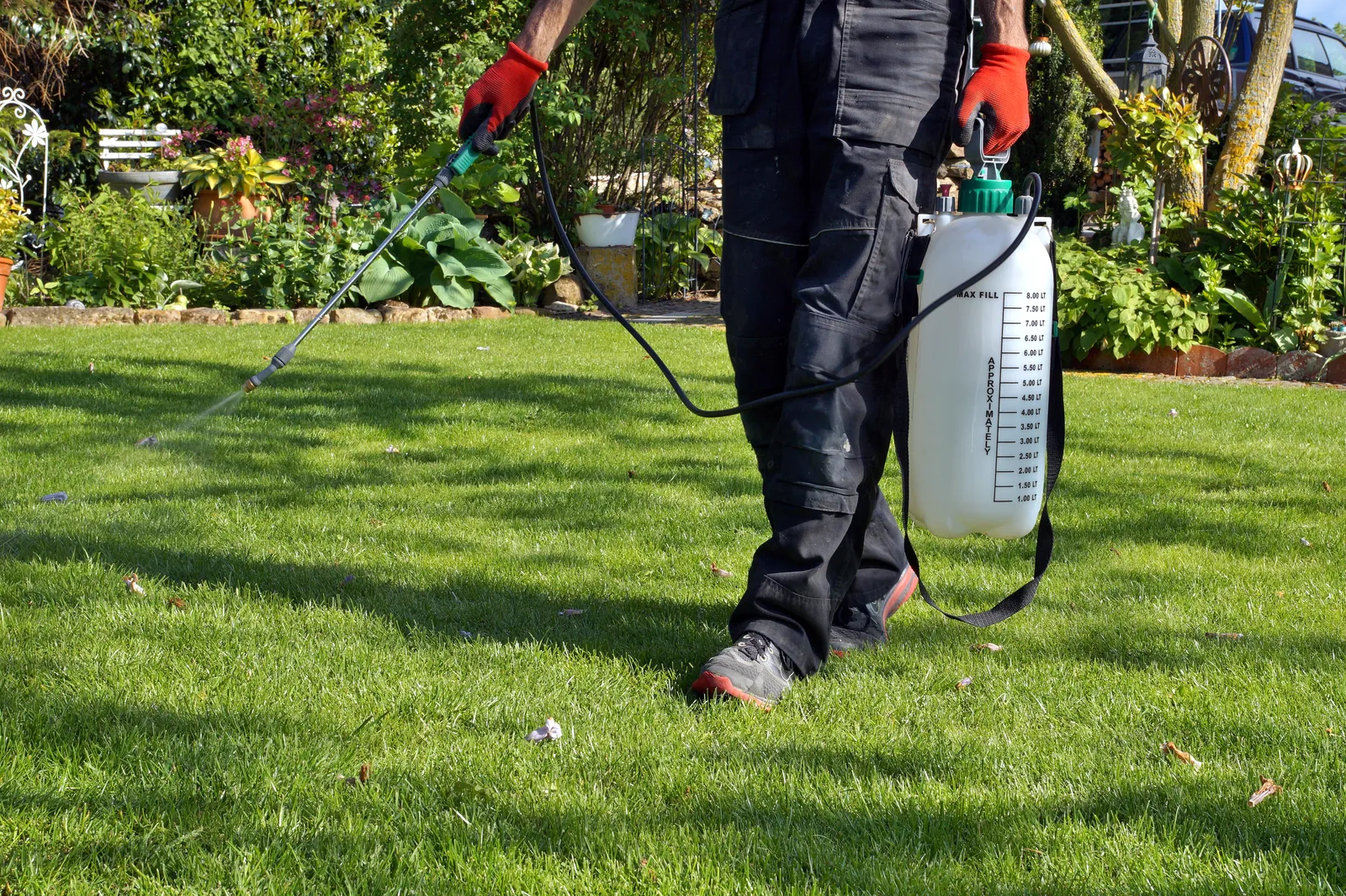
The greenest lawn on the block. Fed, not just sprayed.
Healthy Palm Beach County lawns aren't an accident. They're a four-step quarterly fertilization schedule with weed-and-feed in spring and fall, plus a rainy-season micronutrient feed that keeps the lawn green when PBC's nitrogen ordinance kicks in. About 5¢ per square foot covers fertilization, weed control, insect control, and disease control. The lawn pays you back in twelve weeks.
Family-owned since 1998St. Augustine specialistsFDACS Lic. #JF8626
Family-Owned Since 1998
Quarterly fertilization with spring/fall weed-and-feed — about 5¢ per square foot, all-in.
● Florida-Friendly Chemistry● PBC Fertilizer Ordinance Compliant● Slow-Release N · Iron · Sulfur● Sport Turf & HOA Programs
Four steps. One year.
The PBC fertilization calendar.
South Florida turf needs different inputs than the rest of the country. We follow the UF/IFAS fertilization schedule for your turf type, modified for the local ordinance and the rain pattern.
February
Spring weed-and-feed
Slow-release nitrogen + iron + magnesium. Wakes up the turf without forcing rapid blade growth (which invites disease). Plus a pre-emergent for crabgrass and goosegrass before they germinate.
May
Pre-rainy-season feed
Half-rate slow-release nitrogen plus potassium for stress tolerance. Heavy nitrogen before rainy season is wasted — it leaches into groundwater (and violates PBC ordinance). Light feed builds the lawn up to ride out July–September.
August
Mid-season micronutrient
Chelated iron, manganese, and sulfur foliar. By late summer, PBC sand soils have leached most micronutrients. We spray a chelated foliar to green up the lawn without adding nitrogen during the rainy-season blackout window.
November
Fall weed-and-feed
Full-rate slow-release nitrogen now that the rainy-season ordinance is over. Plus a post-emergent for winter broadleaf weeds (chickweed, oxalis, dollarweed). Lawn goes into winter strong, holds its color through January.
By the numbers
June 1
to September 30 — Palm Beach County's nitrogen blackout window. No N or P fertilizer applied.
PBC Code 78-23 prohibits applying nitrogen and phosphorus fertilizer during the rainy season — too much leaches into the Lake Worth Lagoon and Loxahatchee. We're licensed under it. Most homeowner products on the shelf at the big-box stores are not blackout-compliant. We use micronutrient-only products in summer and rebuild N stocks in November when the ordinance lifts.
When a lawn isn't responding
Soil testing is available — when we need it.
For most PBC lawns, the quarterly weed-and-feed schedule does the job. But sometimes a yard yellows even with the right feed — usually because PBC sand soil has shifted alkaline (pH above 7.2) and the iron in your fertilizer is chemically locked out. When that happens, we run a soil pH and nutrient profile to dial in the program. It's not a default step — it's a tool we pull out when a lawn isn't responding.
Compare
DeBugem vs. lawn-only chains.
National lawn services apply by calendar, with one product. We adjust to your soil and your turf.
DeBugem
Big national chain
DIY (bag from Home Depot)
Soil testing available when a lawn isn't responding
✓
×
×
Slow-release nitrogen formulations
✓
✓
fast-release usually
PBC fertilizer ordinance compliant
✓
✓
often not
Adjusts product per turf cultivar
✓
×
×
Sport-turf and fairway protocols
✓
×
×
Annual cost (1/4-acre St. Augustine)
$520 / year
$680 / year
$240 + frustration
A note on pest control
This page is fertilization. Pests live next door.
Why we keep them separate
Lawn fertilization and lawn pest control are two different chemistries with different schedules and different licensing. Bundling them together means one of the two gets shortchanged. We license, train, and route them as separate services so you get the right thing applied at the right time.
During fertilization visits we always note any pest pressure we observe — sod webworms, chinch bugs, fire ant mounds, white fly — and email a heads-up. If you want us to treat, we add a pest visit on the schedule.
Lawn pest issues we treat separately
Sod webworms (May–Oct) · caterpillar damage
Chinch bugs (Jun–Sept) · sucking insect damage to St. Augustine
White grubs (year-round) · root-feeding larvae
White fly on ornamental hedges
Fire ants · mound treatment
Brown patch fungus (Nov–Mar)
Mention any of these when you book and we'll quote the pest visit alongside the fertilization program.
What's in every visit
What you get on the quarterly program.
Slow-release nitrogen blend formulated for your turf type and the season (spring vs. fall vs. blackout).
Spring weed-and-feed (February): pre-emergent for crabgrass and goosegrass.
Fall weed-and-feed (November): post-emergent for winter broadleaf weeds.
Mid-season micronutrient feed (August) during the rainy-season nitrogen blackout.
Iron + manganese chelate to maintain green-up without forcing top growth.
Spot-treat any weed escapes between visits — included, no extra charge.
Soil pH and nutrient profile available when a lawn isn't responding to the standard feed.
Mowing height and irrigation timing recommendations specific to your turf cultivar.
Notes-to-homeowner email after every visit summarizing what we applied and what we noticed.
Honest pricing
What it costs.
All quotes are flat. Final number depends on lot size, current condition, and turf type. About 5¢ per square foot covers everything: insect control, disease control, weed control, and four fertilization visits a year.
Our standard recommendation is the quarterly plan — the right amount of treatment for most lawns. If you need something different, give us a call. Flexible service available with flexible pricing.
Quarterly · standard
$110 – $180 / quarter
Four visits per year on the PBC seasonal calendar. Includes pre-emergent in spring, post-emergent in fall, micronutrient in summer. Best for residential lots up to 1/2 acre.
Most yards: $130 / quarter
Estate / 1+ acre
$240 – $480 / quarter
Same four-visit schedule scaled up for larger properties. Common in Wellington, Polo Club, Old Floresta.
Quoted by acreage
Sport turf
From $260 / month
Putting greens, polo fields, sport-grade Bermuda. Higher cadence (often monthly), tighter pH targets, and post-rain micronutrient supplements. Three Wellington properties currently on this tier.
Quoted per acre
One-off fertilization (single visit) available at $160–$320 — best for special-event prep (graduation, wedding, listing photos).
FAQ
What people ask before they hire us.
Can't I just buy a bag of Scotts and put it down myself?
For an average year, yes — but most consumer fertilizers in PBC retail are too high in nitrogen, contain phosphorus (banned during summer blackout here), and don't account for our alkaline sand soil. The DIY math usually works out cheaper on paper but the lawn doesn't reach the same depth of color. Also: PBC ordinance violations carry $250 fines and fertilizer runoff is the #1 contaminant in the Lake Worth Lagoon — worth knowing.
Why do you not fertilize June through September?
PBC Code 78-23 prohibits applying nitrogen and phosphorus during rainy season. Heavy summer rain leaches it into groundwater, the Intracoastal, and the Lake Worth Lagoon — where it causes algal blooms. We use iron and micronutrient foliars during the blackout to keep the lawn green without violating the ordinance.
Is your fertilizer safe for kids and pets?
Yes. Granular fertilizer is safe once watered in (usually within 30 minutes). The slow-release nitrogen we use is a coated urea — even at unwatered direct contact it's not toxic. Pets and kids back outside same day.
What about weeds — torpedo grass, doveweed, dollarweed?
All three are tough PBC weeds. We use a professional broadleaf herbicide for broadleaf escapes, a crabgrass-specific herbicide for crabgrass, and a nutsedge-specific herbicide for nutgrass. Torpedo grass in St. Augustine has no selective herbicide — only mechanical removal works. We'll tell you honestly during the assessment.
Do I need to mow before or after you come?
After. Mowing immediately after a granular fertilizer can scatter it. Wait at least 24 hours, ideally let one irrigation cycle run first. We email a confirmation note within an hour of treatment.
Will my lawn green up immediately?
Iron foliars: 3–5 days. Slow-release nitrogen: 2–3 weeks for full color. The reason we use slow-release rather than fast-release is sustained color across the whole quarter — a fast-release blast would spike then fade in 5 weeks.
Want a thicker, deeper green lawn?
Quarterly fertilization programs across Palm Beach County. Soil-tested. Slow-release. Real results.