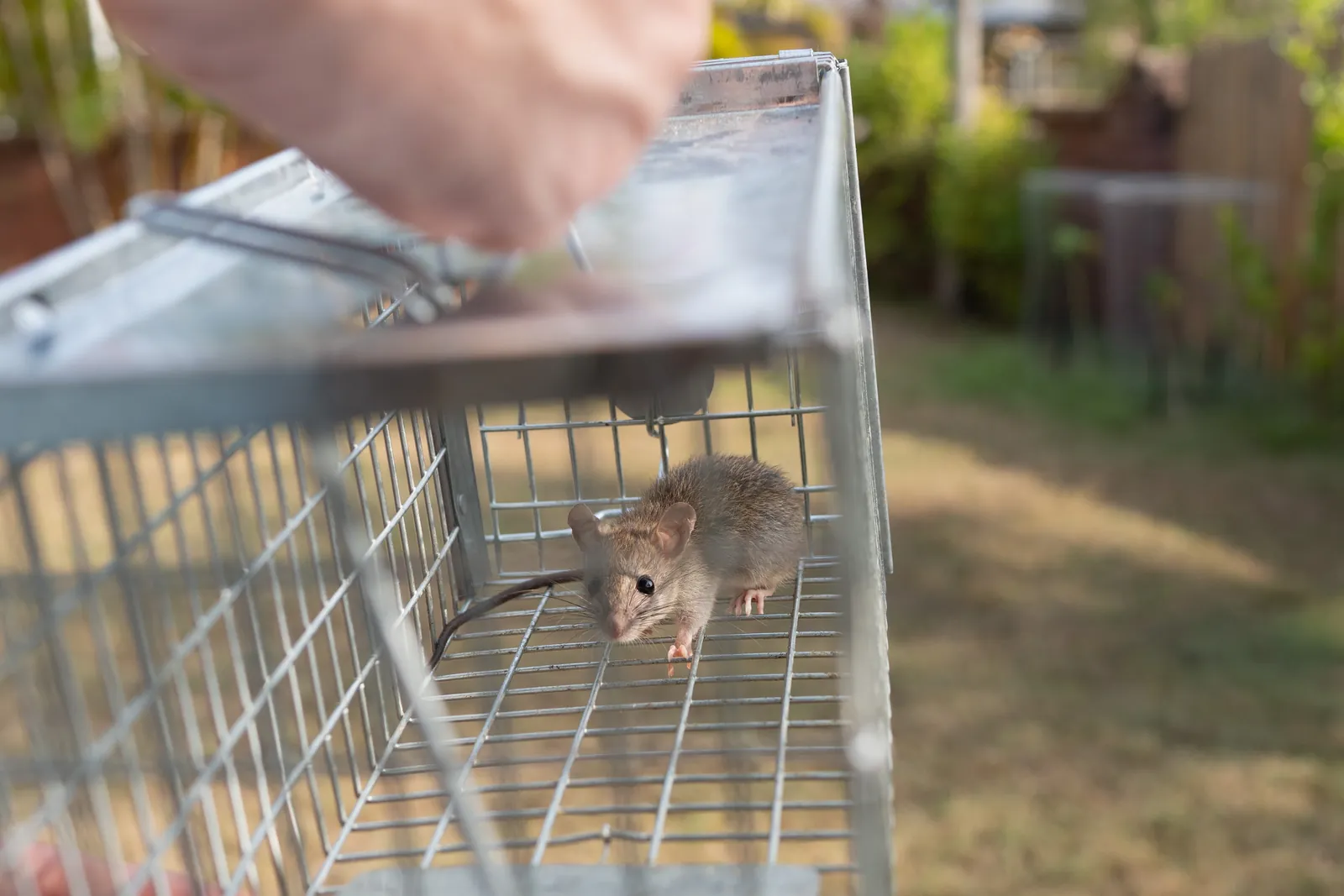
Trapping alone is whack-a-mole. We do trap-and-seal: identify every entry point first, exclude with hardware cloth and copper mesh, then trap whatever's already inside. That's how an attic rat problem stops being a recurring November phone call.
1,400+ exclusions completed30-day re-entry warrantyAttic decontam available
Trap. Seal. Done.
If rodents come back through a sealed entry within 30 days, we re-seal and re-trap free. In writing.
● No Bait Inside Living Spaces● Hardware Cloth + Copper Mesh● 30-Day Re-Entry Warranty● Attic Cleanout & Decontam
Three rodents. Three approaches.
Know your rat. Treat it right.
Different rodents enter differently and respond to different methods. Misidentifying the species is the most common reason an exterminator's program fails in PBC.
#1 in PBC
Roof rats (Rattus rattus)
The dominant rodent across Palm Beach County. Climbers, not diggers — they jump from oak limbs and palm fronds onto barrel-tile roofs and find soffit gaps and HVAC penetrations. Active Nov–Mar mostly. Found from Jupiter to Boca.
Treatment: tree trimming back from roof + soffit exclusion + interior snap traps
Coastal & commercial
Norway rats (Rattus norvegicus)
Larger, ground-dwelling. Burrow under sheds, riprap, and dock structures. More common in commercial corridors and the Intracoastal coastal strip. Less common in residential PBC.
The small one — confused with juvenile rats often. Squeezes through 1/4-inch gaps. Lives in pantries, garages, and engine compartments. Less seasonal than rats; a year-round problem in older PBC homes.
Treatment: snap traps + exclusion of all 1/4″+ gaps + sanitation review
By the numbers
7
litters per year, per pair. Six pups per litter. That's why a "small problem" becomes a real one in 90 days.
A roof rat reaches sexual maturity at 12 weeks. If you saw one at Thanksgiving and ignored it, by Easter you have 30+ in the attic. The math is unforgiving — and the longer you wait, the bigger the cleanout.
The process
Trap-and-seal, in five steps.
Free attic inspection
A licensed tech walks the attic, soffits, and exterior — flashlight, ladder, and a tablet. Marks every gap larger than 1/4 inch and every active trail.
Identify entry points
Soffit returns. HVAC penetrations. Plumbing chases. Tile-roof valleys. Garage door corners. Photo each one and write the access plan.
Seal the building envelope
Hardware cloth (1/4″ galvanized) screwed and sealed at every gap. Copper mesh in voids. Stainless steel wool around plumbing penetrations. Never just foam.
Trap the active population
Snap traps in attic and crawlspaces — never in living areas, never bait blocks where a dead rat could end up in a wall. We check every 48 hours until clear.
Decontam & warranty
Optional attic insulation cleanout if contamination is heavy. We back the seal work with a 30-day re-entry warranty: if anything gets in through what we sealed, we re-seal free.
Compare
DeBugem vs. the bait-only chains.
A bait box outside your house is not a rodent program. Here's the difference.
DeBugem
Big national #1
Bait-only services
Full attic & soffit inspection
✓
×
×
Hardware cloth exclusion (not just foam)
✓
foam only
×
Snap traps over bait inside
✓
bait blocks
bait blocks
Tree trim recommendation report
✓
×
×
30-day re-entry warranty
✓
×
×
Price for typical 2,400 sq ft house
$650 – $1,100
$1,400 – $2,200
$45/mo · forever
Bait-only services charge less per month but never solve the problem — the rats keep coming. The exclusion approach has a real endpoint.
The principle
Why we don't bait inside.
Bait kills the rat. Then kills your wall.
An anticoagulant bait kills a rat 3–7 days after consumption. By then the rat is in your wall void. Decomposing rats inside a wall produce a smell that lasts 3–6 weeks and is impossible to fully remove without opening the wall. We've cut into too many drywall panels for customers who hired the cheap option.
Bait outside, in tamper-resistant stations, is fine. Bait inside the building envelope is malpractice.
Snap traps + exclusion = real endpoint.
Snap traps — kill instantly, recoverable. We bag the carcass on the spot.
Hardware cloth + copper mesh — physical barrier rodents can't chew through. Lasts the life of the house.
Door sweeps & threshold seals — closes the 1-inch garage gap that's the #1 entry point in PBC.
Tree trim recommendation — branches more than 6 ft from the roof give rats no jump-on point.
DIY check
Six signs you have rodents right now.
If you see any of these, call this week. The longer you wait, the bigger the seal-up.
Sign 1
Droppings under the sink
3/4-inch capsule-shaped droppings = roof rat. Pencil-tip droppings = mice. Both mean active infestation, not "they passed through."
Sign 2
Scratching above the ceiling at dusk
Roof rats are nocturnal and most active right after sunset. If you hear scratching in the soffit or attic between 7–10 PM, that's the give-away.
Sign 3
Greasy smudge marks along baseboards
Rodents follow walls. Their fur leaves a dark, oily smudge along the route — usually from the entry point to the food source.
Sign 4
Chewed garage corners or AC line insulation
Rats chew to keep teeth filed. AC line foam, garage door corner trim, and weather stripping are the favorites in PBC homes.
Sign 5
Pet acting fixated on a wall or ceiling
Cats and dogs hear the rats long before you do. If your pet is staring at the same spot for 10 minutes, that's the spot.
Sign 6
You see one in the daytime
Rodents are nocturnal — daytime sightings mean the population is high enough to push activity into off-hours. That's no longer a "preventive" call. Call now.
FAQ
What people ask.
How long does the snap-trap-and-seal program take?
Anticoagulant baits kill rodents 3–7 days after consumption — by then they're inside your wall void. Decomposing rodents inside walls produce a 3–6 week smell that cannot be removed without opening the wall. We've cut into too many drywall panels for customers who hired the cheap option.
Is the exclusion guaranteed?
12-month rodent-entry warranty on every exclusion job. If a rodent gets back in through any sealed point, we re-seal at no charge.
What about poison stations outside?
Tamper-resistant exterior bait stations are fine — rodents that take bait outside die outside, in the yard or back at their nest in a tree. We use them on commercial accounts and at the perimeter of homes with severe pressure. Just not inside the building envelope.
Hearing them above the ceiling?
Snap-trap + exclusion = a real endpoint. Same-day inspection across PBC.